It’s been already a few years since I play around in my head with the following situation. I imagine myself as being just “switched on” (or initialized like a computer or any other electrical device) at the exact moment in which I’m having such a thought, that is, I imagine myself as a new entity that has just been created and placed inside the world that I perceive through my senses. As such, all the contents of my memory, knowledge, skills, etc. have just been placed inside my mind in order to give me the illusion that I am who I claim to be, with the past, knowledge, skills, etc. that I claim to possess. If that was true, then it was not me who played drums in a band contest at 15, nor it was me who got into a fight in high school, nor it was me who cycled from home to the desk where I am sitting now. If that was true, those memories were implanted in my mind just before I was “switched on”.
I like playing around in my head thinking about such a situation, because I know that nothing: no subterfuge from the mind or the world outside can be used to prove that it is wrong. Of course, I am aware that if it was true, then the world -or at least some part of it- contributes to the maintenance of the illusion in which I live in, both outside and inside of me, which includes not only what it is generally understood as memory but also skills of mental, motor, and verbal nature, among others.
What do I count on with in order to sustain the legitimacy of my memory? It is funny to think about this, because it could be argued that memories are the only legitimate property that we can own. You can sell your house, lose your money, give away your books and even your clothes, but your memories are something that you cannot exchange. At least this is what we believe. But if the situation that I have just described above is true -and we don’t have any arguments to invalidate it completely-, then we cannot be entirely sure that we are the legitimate owners and creators of our own memories.
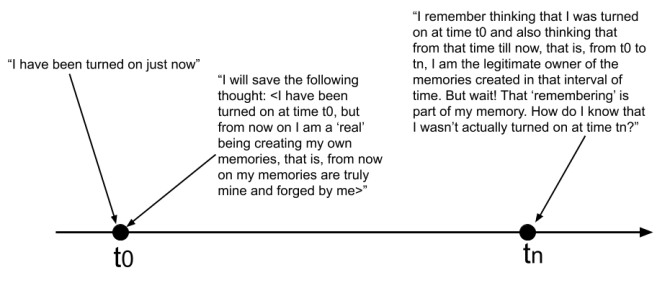
Whenever I play around with this idea, I say to myself: “ok, I know that I cannot prove the legitimacy of my memory at this very instant in which I realized that I might have been ‘switched on’ just now, but from now on, from this instant on, I can truly be sure that the memories I make are truly mine, that is, I forged them myself”. In other words, I say to myself “alright, I know that I have been ‘switched on’, say at 5pm. But I can be sure that all memories formed in my mind from 5pm on are memories that are truly mine. Moreover, I can put an alarm at 6pm to remind me that before 5pm all my memories were spurious, that is, of uncertain origin; but from 5pm to 6pm -when I listen to the alarm- I can be sure that the memories I have during that period of time are truly mine.”
I thought that that could be a way to solve the conundrum, but then I realized that even at that second time -6pm, in the example above- all I have is memory, and it could be also the case that even that thought (“from 5pm to 6pm I can be certain of the legitimacy of my memory”) was also implanted. In other words, at 5pm the thought: “from 5pm to 6pm I can be certain of the legitimacy of my memory” is legitimate because it is thought at present time -that is at 5pm-, but then at 6pm the same thought is of uncertain legitimacy because it belongs to memory as it is past time (see the image below).
Memories are also social in the sense that I not know about myself and my past only from what my own memories tell me, but also from the memories that others have of me and the situations that we experienced together. In case I doubt of the memory that says to me that this afternoon I had coffee with a colleague, I could simply ask my colleague if that was the case. However, the fact that memories are social, and that we share them with others, don’t help us to solve the dilemma of proving the legitimacy of memories, because as I mentioned above it could simply be the case that people, whom I believe I shared memories with, are just keeping the illusion alive. Examples of this situation can be found in films like The Matrix, Total Recall, Ghost in the Shell, and Blade Runner. In the latter, the character of Rachael experiences a situation like the one I have described above. She discovers that the memories she has actually belong to his employer’s niece. And that before she discovered that, everyone around her were just playing their part to keep the illusion alive.
I have said that they who doubt about the legitimacy of their memory do not have anything to help them legitimize it. But, who the hell doubts the legitimacy of their memories as in the situation that I have described above? To do it, that is, to doubt the authenticity of our memory requires to be crazy -not to say an idiot-, or an extreme skeptic -of proportions comparable to that of Hume-, or a stubborn philosopher, or a narcissistic solipsist, or a believer of conspiracy theories, or all of the above! (I for one can say that I possess a little bit of all these.)

 The Thoughtist